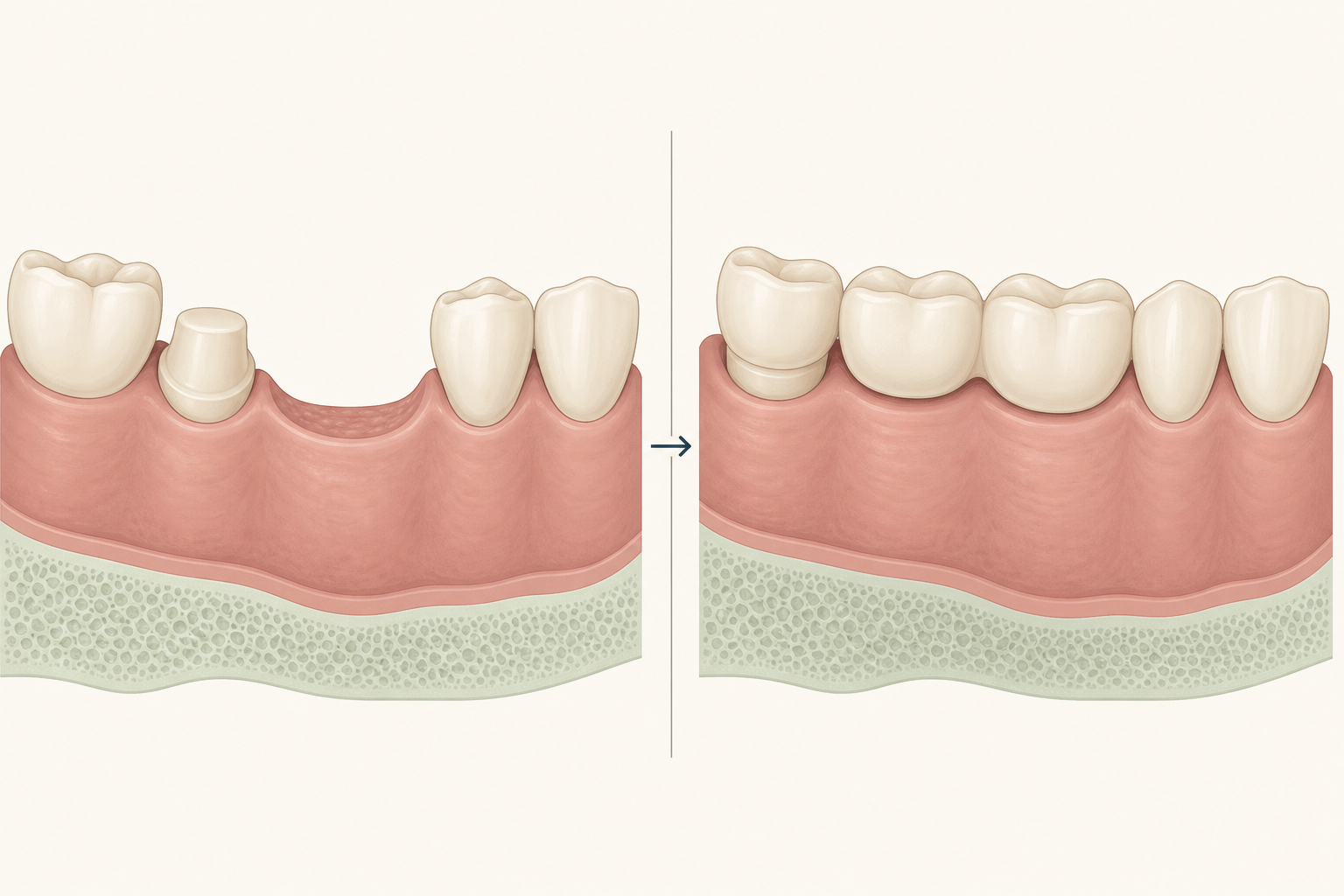
This bridge replaces a missing tooth where support is available on only one side of the gap. The number of missing teeth, gap size, condition of neighbouring teeth, gum health and the person's preferences all inform bridge planning.
Local anaesthetic is used before the supporting tooth is reshaped. Some enamel must be removed to make room for the crown, and that change cannot be reversed.
All-ceramic cantilever bridge reviews report that biological complications are uncommon; technical problems, particularly debonding, are reported more often.
A dental bridge commonly lasts five to 15 years and may last longer with care. It is fixed in place but still needs replacement if wear or damage develops.
The supporting tooth is numbed and reshaped, then an impression is sent to a laboratory. A temporary bridge protects the prepared tooth until the final bridge is ready to be bonded.
A traditional bridge uses crowns on both sides of a gap. A cantilever bridge uses a crown on one side, while implant-supported and other fixed prostheses are separate replacement options.
The first appointment includes anaesthetic, tooth preparation, an impression and a temporary bridge. The final bridge is fitted after the laboratory has made it.